28-08-2018 às 23:41
(28-08-2018 às 23:02)Johnny_1056 Escreveu: Boas;
Não deixa de ser vergonhoso ver uma situação destas num dos mais importantes circuitos do mundo que recebe os melhores pilotos do mundo e num país onde chove quase todos os dias.
Os milhões que andam a rolar nas mão de promotores e organizadores deviam ser mais empregues em solucionar situações destas.
Especialmente quando havia antecedentes e ja se tinha avisado... varias vezes...
Sei que e puxadote, mas deixo mais um artigo para quem lhe apeteca ler
Citar:The latest MotoGP mutterings from the washed-out British round, at Silverstone
The two degrees that ruined Sunday
MotoGP made history on Sunday: the first Grand Prix to be abandoned since the 1980 Austrian Grand Prix, which was called off after three feet of snow fell on the eve of practice.
Salzburgring 1980 was 37 years and more than 500 races ago. In other words, this kind of thing doesn’t happen often.
So why did it happen on Sunday? Best deal with this chronologically.
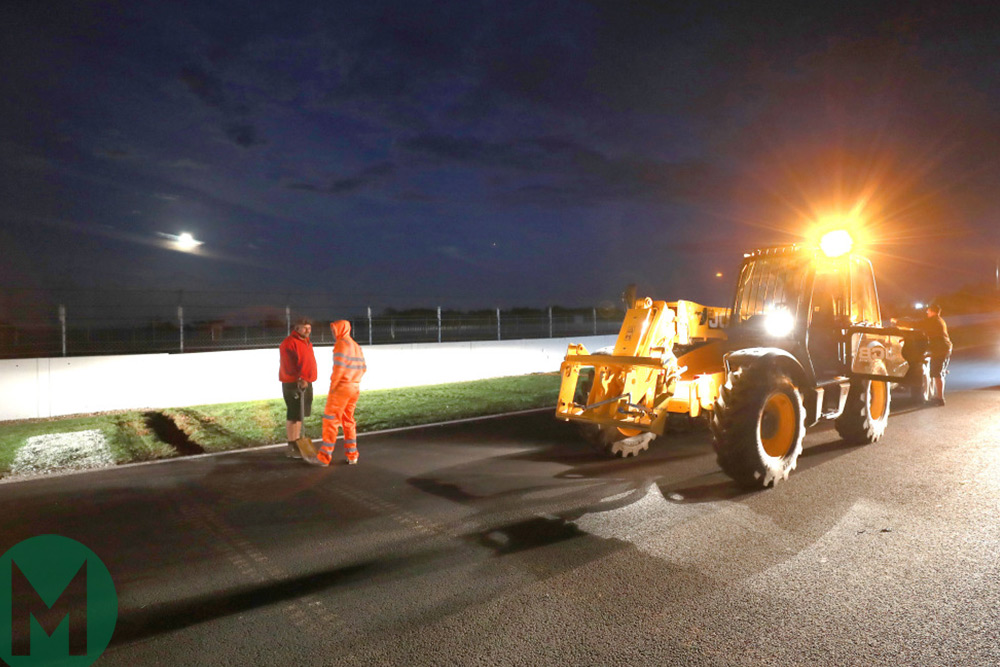
Silverstone had need resurfacing for a while. I hugely enjoyed watching Valentino Rossi control his spinning, bucking Yamaha across the bumps and through the puddles in 2015 (one of his greatest victories, in my opinion), but it was obvious then that the track needed some TLC. Silverstone hadn’t had a full resurface since 1996, so the plan was to replace the patchwork of different asphalts with a uniform surface, while also smoothing out bumps and improving drainage.
Ahem.
Silverstone engaged Aggregate Industries to do the job. AI is a huge concern with an annual turnover of more than £1 billion. The company lays, maintains and resurfaces almost half of Britain’s motorways and major trunk roads. AI has also worked on numerous high-end projects, like the Queen Elizabeth II Bridge at Dartford, the Shard skyscraper, the Channel and Mersey tunnels and so on. They should know what they’re doing, but obviously they don’t know enough about racetracks.
The new asphalt was laid in early February, just before the ‘Beast from the East’ hit Britain, so it endured the country’s coldest winter in decades, followed by the longest summer heatwave in decades. The heat wasn’t a problem, because asphalt is mixed at 350 degC. It was the cold weather that was the problem, because in cold conditions the asphalt cools too much during the laying process, which makes the surface difficult to compact and create the desired degree of smoothness and camber for drainage.
MotoGP safety officer and 1982 500cc world champion Franco Uncini wouldn’t have noticed these issues when he inspected the new surface at the end of February, because the only way to really evaluate a track for MotoGP bikes is by riding a MotoGP flat out in all conditions. This wasn’t possible because teams didn’t have time to try the circuit in the frantic early stages of the season.
But the new surface was used by bikes and cars. In April, Bemsee (Britain’s oldest motorcycle-racing club) had a race weekend at Silverstone, when riders reported aquaplaning on Hangar Straight during heavy rain. Weeks later Formula Ford drivers found the same problem, some of them spinning off into the gravel at speed, due to standing water at various parts of the track.
In May, Cal Crutchlow evaluated the new surface in the dry, riding a Honda RSV213V-S road bike. He was impressed and predicted the lap record would fall by more than a second. But he did ask for a few bumps to be smoothed out. Former 500cc GP winner and Dorna’s current pitlane commentator Simon Crafar tried the new surface during a track day and suggested more bumps needed smoothing out. Consequently, workers were called in to use grinders to remove high spots where required, but this also polishes the surface, reducing grip.
To further complicate matters, the British Formula 1 Grand Prix took place on July 8 and the four-wheel World Endurance Championship on August 17. Both F1 and WEC cars use skid blocks that polished more areas of the asphalt to a mirror finish, especially at the end of Hangar, where speeds and therefore downforce are at their highest.
Thus, all that was required to complete the perfect storm was a British summer downpour over the MotoGP weekend.
So, who is to blame? Firstly, Aggregate Industries. A company like AI – which has been around since the 1850s! – shouldn’t mess up a job like Silverstone. But they did, big time, perhaps because they have no real experience of racetrack work.
The problem isn’t lack of drainage through the asphalt, as assumed by many (myself included). This is not how asphalt drains. All road surfaces need a minimum of two percent cross slope for rainwater to drain off either side of the road or racetrack.
Racetracks aren’t crowned like normal roads to aid drainage, because a crown in the middle of a racetrack requires riders to deal with four changes of camber as they ride through each corner: as you peel in from the outside of the track you go from positive camber and over the crown to negative camber as you approach the corner apex on the brakes. Not nice. Then when you get on the throttle you go from positive camber and over the crown to negative camber, at the very moment you try to open the throttle fully. Also not nice.
Assen was the only MotoGP track that had a street-type crown in the middle with a camber to left and right, but the track was flattened a few years ago to reduce accidents and injuries caused by those multiple changes of camber.
But even without a proper crown in the middle of the track you need a profile that slopes to left and right. It is the lack of that two-degree slope that ruined everyone’s day on Sunday, especially in the undulating sections like the approach to Stowe and Vale, where small lakes of standing water gathered to make the track treacherous at best and lethal at worst.
Quite simply, you cannot run a race when there is danger of aquaplaning.
Obviously, Silverstone is also to blame. They should have had the world’s best racetrack construction experts advising Aggregate Industries throughout the process. And they should have listened to the complaints of Bemsee bike racers and Formula Ford drivers, if these people did indeed complain.
But Dorna and the FIM also share the responsibility. The racetrack belongs to Silverstone, but the event belongs to the MotoGP rights-holders and the sport’s governing body, who should communicate with bike racers who use a track that’s been modified or resurfaced before a major event.
“The FIM track inspection process during and after a full or partial resurfacing isn’t good enough; they need to be more involved,” WSB rider Chaz Davies tweeted on Sunday night. “They are aware of my opinion but I’m yet to see change.”
Finally, what about Sunday? The day was a misery for tens of thousands of bedraggled spectators.
The first priority of Dorna and Silverstone was to make the headline MotoGP race happen, so to beat the rain it was brought forward to 11.30am, the earliest that teams could cope with following the 9am warm-up. But as soon as the riders rode out for their sighting lap the drizzle turned into a downpour. The standing water was already so bad that riders were spinning and getting sideways as soon as they rode out of pit-lane towards Maggotts.
“We want to race, but in safer conditions,” said Suzuki’s Alex Rins, who had jumped off his GSX-RR at around 100mph during Saturday’s FP4 session when he aquaplaned on the lake at the end of Hangar Straight. “It was almost impossible during the sighting lap – in second gear and third gear with just 15 per cent of throttle the rear was spinning like crazy. So imagine what it would be like with 24 riders actually racing.”
It’s worth mentioning that the Isle of Man TT used to stage races in the rain but no longer does so. Likewise, races at this year’s North West 200 were red-flagged and cancelled due to the weather.
Many fans have criticised Dorna and Silverstone for waiting so long before abandoning the event, but the long, tedious wait was in the hope of a big enough respite from the rainfall. Live Met Office weather maps suggested there would indeed be a window during the afternoon, so the race was briefly scheduled to start at 2pm; which was again delayed to 4pm, after a final safety commission meeting between the riders, MotoGP safety reps and Dorna.
Meanwhile other fans have criticised Dorna and Silverstone for not waiting long enough, when there was a bigger window in the weather forecast for the early evening.
Throughout the day MotoGP safety reps and former world champions Uncini and Loris Capirossi drove numerous fast laps in BMW safety cars to continually assess, in case it dried out enough to go racing. They never thought it did, which is why there wasn’t another sighting lap.
However, some riders – Jack Miller, Johann Zarco, Scott Redding and one or two others – did want to try to race. “You just need to get heat into the tyres and dodge the puddles,” said Miller. “I think the bikes would’ve cleared the water pretty quick.”
“Tell them all to shut up and let’s go,” added Redding, who didn’t even turn up at the final safety commission meeting.
When riders emerged from that meeting in the IRTA offices the majority had voted that conditions weren’t good enough, with further rain coming in. Whenever Race Direction made a plan, they were confounded by the weather. Saturday evening was beautiful. Sunday morning was okay, until the bikes went out. And an hour or so after the meeting was abandoned the sun came out. But by then, team artics were already leaving.
A few teams did want to try to race at 6pm or 7pm. Others wanted a Monday race, but this was a logistics nightmare, with 300 artic lorries booked across the Channel on Sunday night/Monday morning and 2000 paddock staff booked on planes. In addition, Silverstone was unable to secure the required number of police and circuit staff at such short notice.
People who suggested the promoters couldn’t be bothered to make the race happen couldn’t be more wrong. Silverstone wanted the race to go ahead at almost any cost, firstly to keep the fans happy and secondly to avoid paying out millions of pounds in ticket refunds
And people who suggested on social media that MotoGP riders “need to grow a pair” should hang their heads in shame. Safety must always be the highest priority. And to suggest that Crutchlow, Marc Márquez, Valentino Rossi are somehow delicate and frightened is laughable.
Perhaps Silverstone’s biggest failure was not keeping the fans amused. The situation was in meltdown, the track and the teams in a constant state of alert, in case the weather suddenly did improve.
In hindsight, they should’ve sent out the riders on a truck to at least acknowledge the crowd, but the riders were in a constant state of alert, ready to scramble if the race went ahead. Even better, they should’ve sent them out in 20 hire cars. Believe me, there are few things funnier than watching a bunch of bike racers racing each other in rental cars. But it didn’t happen.
Right now, what happens next is important. Communications between Silverstone and Aggregate Industries will be interesting in the next weeks and months. Surely, AI need to do the job again, for free, with racetrack experts ensuring they get it right this time. The problem, of course, is finding a long enough free period to lay and cure the surface when the weather isn’t too cold.
Are bumps such a bad thing?
Throughout Friday and on Saturday morning, the British Grand Prix ran perfectly smoothly. Well, apart from the bumps.
The first inklings that things weren’t quite right with the new surface came after FP1 and FP2. The combination of cold wind, bumps and high-speed corners had a few riders looking a whiter shade of pale.
“It’s a shame because Silverstone is a very nice track with some very fast corners,” said Aprilia’s Aleix Espargaro. “But now we are trying to avoid crashing on the bumps instead of focus on being fast. Our bike is super-unstable, plus we’re not putting enough temperature into the front tyre, so it’s a bit scary.
“This isn’t easy to fix because you want to make the bike longer to gain stability, but also we want to raise the bike to put more temperature in the tyres [by increasing load transfer during acceleration and braking]. We did this in FP2 and increased tyre temperature by a few degrees, but now the bike is worse on the bumps, so it’s a very difficult compromise.”
Espargaro used a new frame at Silverstone, with shallower main beam sections to increase flex to improve turning and bump absorption.
Diminutive Repsol Honda rider Dani Pedrosa had a more challenging time than most, because he’s not heavy enough to get heat into the tyres and not big enough to wrestle the bike over the bumps. And he can’t fix the problem with electronics.
“The traction control works when you lose grip, via the suspension, the tyre or the track temperature,” said the 32-year-old, preparing for his last British GP. “If you don’t have grip when you lose load jumping over the bumps, then the traction control thinks that in fact you are spinning, so it starts working when don’t want it to work, then the bike starts shaking and everything becomes confusing. The only thing you can do is set the traction control freer, but when you turn it down you don’t have it when you need it in the corners. So you just have to deal with the situation.”
Valentino Rossi, who ended FP1 a close second to Movistar Yamaha team-mate Maverick Viñales, had his own way of dealing with the bumps.
“From what I understand during my career the secret to riding a bumpy track is to not care,” said the 39-year-old who was hoping to end Yamaha’s 21-race victory drought. “If you start trying to ride in a different way or you don’t attack the bumps or you try to go around them, then everything gets worse. It’s a bit like motocross: if you are scared of the bumps it’s worse, so you have to go and hope that everything is OK. This is the best way!”
The bumps were bad. Most riders thought they were very bad, but this is partly a consequence of many top tracks getting smoother and smoother, so when riders and bikes come up against a bumpy surface, the negatives are magnified. I have to admit I enjoy watching riders deal with the bumps, muscling their bikes around as the suspension loads and unloads across the peaks and troughs. But that may just be me…
Rossi: "The road is long"
Viñales had the best race pace in the dry at Silverstone, for two reasons: Silverstone is a chassis track, not a horsepower/electronics track, because it’s dominated by fast corners, where maintaining momentum, especially across the bumps, is paramount.
Both Viñales and Rossi also benefitted from work done during a Misano test the previous weekend. “First, this track is friendlier to our M1,” said Rossi. “Also, in FP2 we tried something that Maverick tried at Misano, which was positive. We are working on the electronics in acceleration, and it looks like we’ve made a step forward because our engine is a bit smoother from the bottom, which is important.”
The Movistar team did not have new electronics expert Michele Gadda at Silverstone because Gadda is contracted to the Pata WSB team. Currently Gadda is in a middle of a tug of love between the two outfits.
“Unfortunately Michele isn’t here with us, because he is busy with the superbike team,” added Rossi. “But we have worked together in recent weeks and it looks like we’re starting to move in the right direction with the electronics. The road is long and there’s a lot of work to do, but in FP2 I felt something better, Maverick too, so it’s positive.”
Expect Yamaha to come out swinging at Misano next week: the factory team has tested there and the factory will be working harder than ever to ensure it doesn’t match its longest victory drought since the 1990s.
"A racer’s helmet is a diamond!"
Silverstone’s annual Day of Champions charity event raised a record £290,000, towards improving health in impoverished areas of Africa. The onstage memorabilia auction by Two Wheels For Life raised £103,000 alone. Inevitably, anything to do with Rossi earned the most money, topping out at £3000 for the opportunity to take a selfie with the nine-time world champion.
Johann Zarco was eloquent in his admiration for the event. “I’m impressed by the fans who came to the Day of Champions,” said the Frenchman. “It reminds me of the days when I wasn’t a racer – a top rider’s leathers or helmet look like a diamond to a race fan! These things are sold for a lot of money at the action, which fulfils the dreams of the fans, while at the same time helping an important charity. I think we should do the Day of Champions at other races as well.”
South-east Asia’s First MotoGP team is go
The worst-kept secret of 2018 was finally put to rest at Silverstone when the Petronas Yamaha Sepang Racing Team was officially announced on Friday evening. This is significant news because South East Asia is the only region of the world where motorcycling is really booming.
The new outfit will run Franco Morbidelli and Fabio Quartararo in MotoGP, Khairul Idham Pawi in Moto2 and Ayumu Sasaki and John McPhee in Moto3. The riders were joined at Silverstone by Yamaha factory officials, Petronas CEO Tan Sri Wan Zulkiflee Wan Ariffin and Sepang CEO Dato Razlan Razali.
Morbidelli will get A-spec YZR-M1s, which means 2019 bikes, essentially identical to those to be ridden by Rossi and Viñales, while Quartararo will ride his rookie season on B-spec M1s, basically this year’s bikes. The plan is for the 23-year-old Italian and 19-year-old Frenchman to graduate to the factory team
“At the right time, when our factory team has the places and these riders have the potential, that’s definitely the intention,” said Yamaha racing director Lin Jarvis.
Yet more new electronics rules
New-for-2019 MotoGP technical rules were confirmed at Silverstone. Electronics, as usual, was the big talking point, as MotoGP technical staff work to ensure that all the factories are using the exact-same equipment, with no chance of fiddling the zeroes and ones.
From next year all MotoGP bikes will be restricted to the same Magneti Marelli IMU (inertial platform), a small black box of gyroscopes and accelerometers that help manage the various rider controls by measuring yaw, pitch and lean to tell the ECU the position of the motorcycle in relation to the ground.
The plan for the spec IMU was revealed earlier this year to prevent teams and factories cheating via clever electronics tricks. On Thursday, MotoGP director of technology Corrado Cecchinelli announced another new regulation, also aimed at preventing cheating.
“As well as the unified IMU, which will stop people doing things that aren’t allowed, we will also restrict the layout of the CAN (Controller Area Network) connections on all bikes,” said the former Ducati MotoGP engineer who said he has no proof that any of the teams are actually cheating.
“By restricting the CAN layout we will make it impossible for devices within the electronic system to communicate with each other when they aren’t supposed to communicate with each other.”
A CAN allows the various microcontrollers on a MotoGP bike to communicate with the ECU. MotoGP bikes are allowed four CAN lines: two are used by the IMU box (which is a doubled-up aero-type system with two IMUs, in case one fails), the third is used by the team for other lines and the third is shared with the Dorna onboard module, which sends all the bike info you see on television.
MotoGP technical director Danny Aldridge also confirmed next year’s revised aerodynamics regulations, which tighten up the current rules but won’t make much difference to the look of the bikes.
Teams will only be allowed two different bodywork designs all year. They are allowed two designs this year, but they can remove sections from these to create multiple different options. This won’t be allowed from 2019. All aero will be checked in an official jig, rather like the metal frames used by airlines to check the size of cabin baggage.
Expect most factories to homologate both their aero options early in the season, so they can switch back and forth as required.